| The Public Paperfolding History Project
Created 17/2/2025. Last updated 17/3/2026 x |
|||||||
| The Spanish Giraffe | |||||||
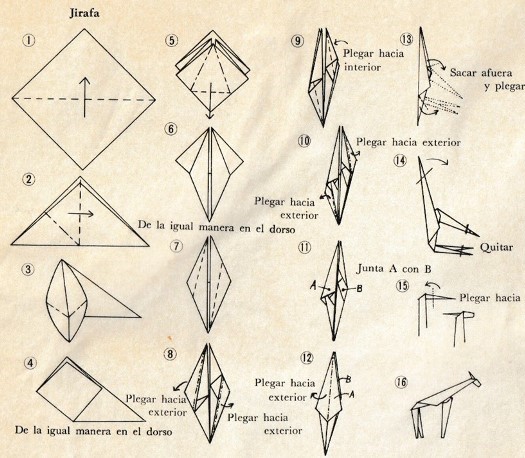
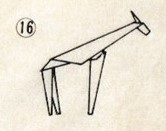
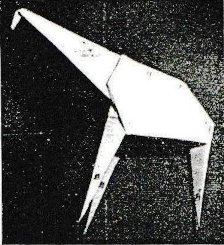
This page is being used to collect information about the paperfolding design I call The Spanish Giraffe, which is developed from a bird base. Cut and uncut versions exist. Please contact me if you know any of this information is incorrect or if you have any other information that should be added. Thank you. In his book 'La Creacion en Papiroflexia', published by Miguel A Salvatella in Barcelona in 1979, Vicente Palacios attributes this design to Miguel de Unamuno. I have not seen any evidence to back up this attribution. ********** In Japan (and in publications by Japanese authors) 1960 The Spanish Giraffe appears as 'Jirafa' in (the Spanish version of) 'Happy Origami: Swallow Book' by Tatsuo Miyawaki, which was published by Biken-Sha in 1960. The horns are uncut but the tips of the legs are cut off in step 14.
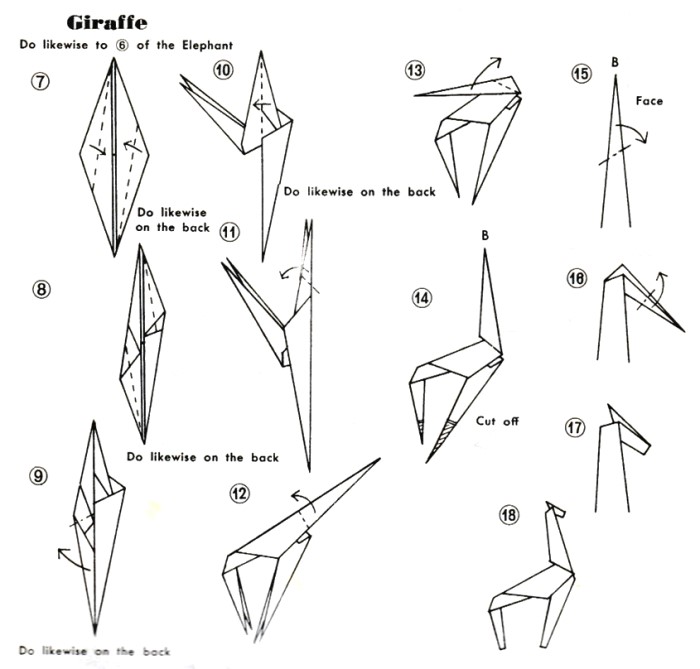
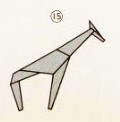
********** A similar design also appears, as 'Giraffe' in 'Pop-Up Origami: Kitty Book' by Tatsuo Miyawaki, which was published by Biken-Sha in Japan in 1960. The horns are not cut but tips of the legs are cut off.
********** 1967 As 'Giraffe' in 'Origami Playtime' by Tatsuo Miyawaki, which was published by Japan Publications Trading Co in Tokyo, New York and San Francisco in July 1967.
********** In Europe and the Americas 1939 As far as I know a heavily cut version of this design first appears as 'La jirafa' in 'El Mundo de Papel' by Dr Nemesio Montero, which was published by G Miranda in Edicions Infancia in Valladolid in 1939. Cuts are used to create the ears and the tail and to separate the back legs.
********** 1940 The same heavily cut design appears as 'Jirafa' in 'El Plegado y Cartonaje en la Escuela Primaria' by Antonio M Luchia and Corina Luciani de Luchia, which was published by Editorial Kapelusz in Buenos Aires in 1940.
********** 1941 An uncut version of the same design appears as 'El Jirafa' in 'Papiro-Zoo: Manual practico de cocotologia o papirologia' by Giordano Lareo, which was published by Larco in Buenos Aires in 1941. Because cuts are not used this version of the design only has one back leg and one horn.
********** 1945 An uncut version of the design also appears in 'Tratado de Papiroflexia Superior' by Vicente Solorzano Sagredo, which was self-published in Buenos Aires in 1945. This design is included in a section devoted to Miguel de Unamuno but is not specifically identified as, or evidenced as being, one of his designs.
********** |
|||||||