| The Public Paperfolding History Project
Created 25/6/2025. Last updated 17/10/2026. x |
|||||||
| The Cut Frog-Base Crab | |||||||
| This
page attempts to record what is known about the origin
and history of the origami design which I call The Cut
Frog-Base Crab. Please contact me if you know any of this
information is incorrect or if you have any other
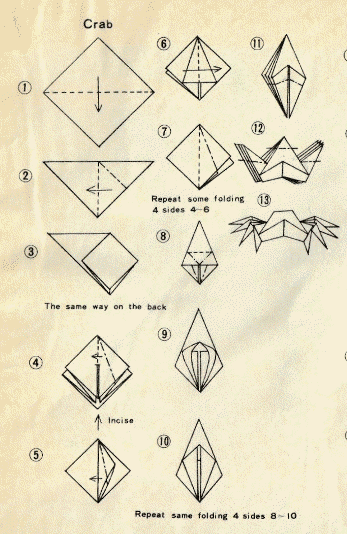
information that should be added. Thank you. ********** In Japan (and in publications by Japanese authors) 1878 A drawing of a crab that seems to have been developed from a frog base using diagonal cuts appears in 'Yochien Onbutsu Zukei', a publication of kindergarten material issued by the Tokyo Women's Normal School in 1878. There are no accompanying diagrams. Note that this crab has ten appendages, two more than the frog base would normally provide, and that the pincers are split. It is not clear to me where these extra appendages would come from. It seems probable to me that the illustrator has simply provided too many sets of legs and that this is The Cut Frog-Base Crab design.
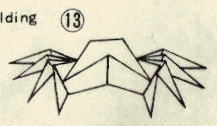
********** 1960 A very similar design appears as 'Crab' in 'Happy Origami: Whale Book' by Tatsuo Miyawaki, which was published by Biken-Sha in 1960.
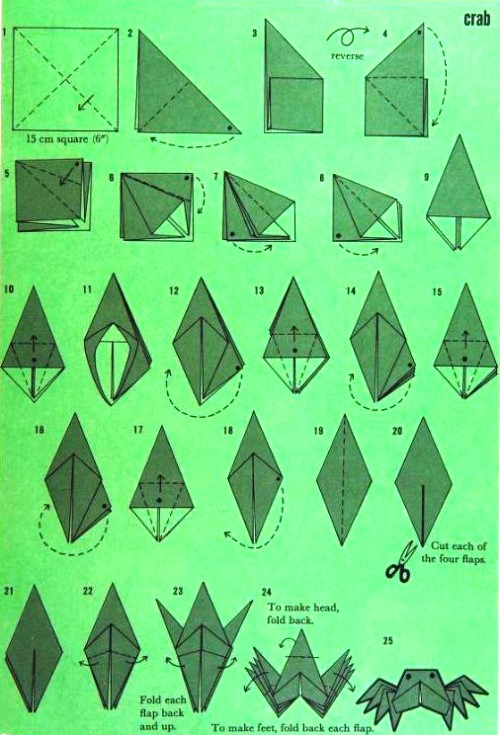
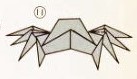
********** The same design appears: 1964 As 'Crab' in 'Fold-and-Paste Origami Storybook' by Florence Sakade, which was published by Charles E Tuttle Company in Vermont and Tokyo in 1964.
********** 1967 As 'Crab' in 'Origami Playtime' by Tatsuo Miyawaki, which was published by Japan Publications Trading Co in Tokyo, New York and San Francisco in July 1967.
********** As 'Crab' in 'Origami Land: Rooster Book' by Tatsuo Miyawaki, which was published by Biken-Sha in matsuyama, Japan in 1967.
********** In Europe and the Americas 1930 In the issue of the French children's magazine 'L'Age Heureux' of 2nd October 1930.
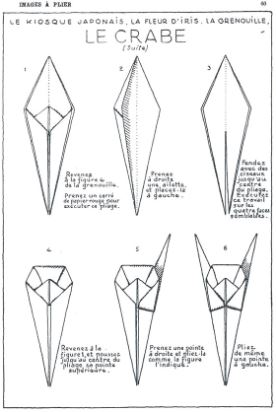
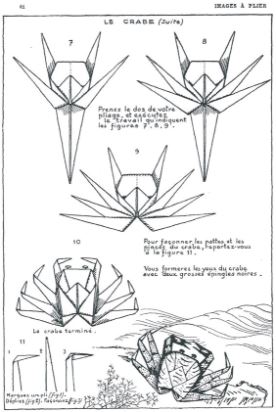
********** 1932 In Booklet 4 of 'Images a Plier', a series of 6 booklets published by Librairie Larousse in Paris in 1932.
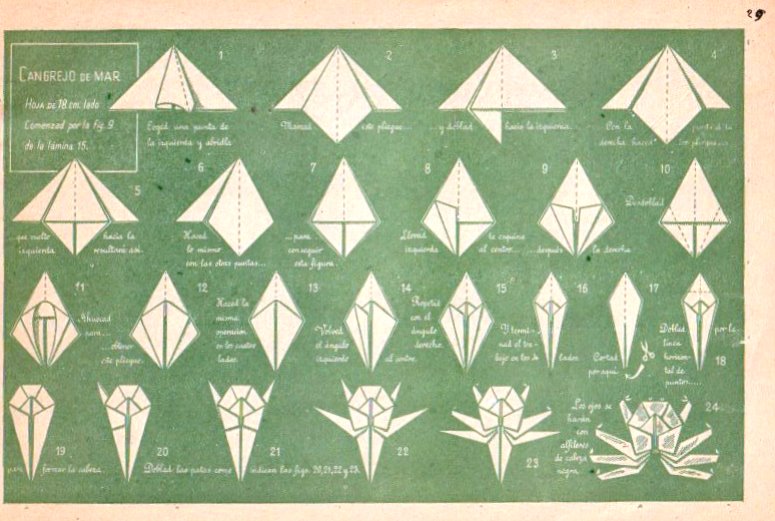
********** c1936 As 'Cangrejo del mar' in 'El Plegado de Papel: 4th Cuaderno de Trabajos Manuales', which was published anonymously by J Ortiz in Madrid around 1936.
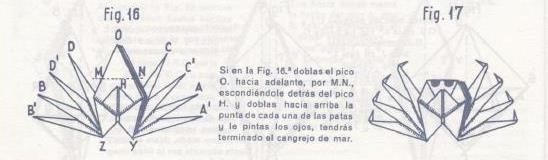
********** 1939 'El Mundo de Papel' by Dr Nemesio Montero, which was published by G Miranda in Edicions Infancia in Valladolid in 1939, contains diagrams for a crab, 'El cangrejo del mar' which is essentially similar to the design in 'Images de Plier'.
********** |
|||||||