| The Public Paperfolding History Project
xCreated 22/11/2026. Last updated 22/11/2026 x |
|||||||
| Article in Utrechtsch Nieuwsblad, 12th November 1955 | |||||||
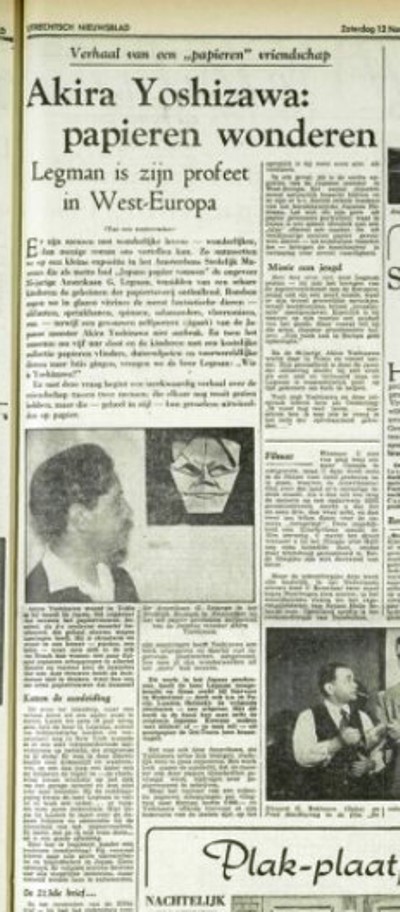
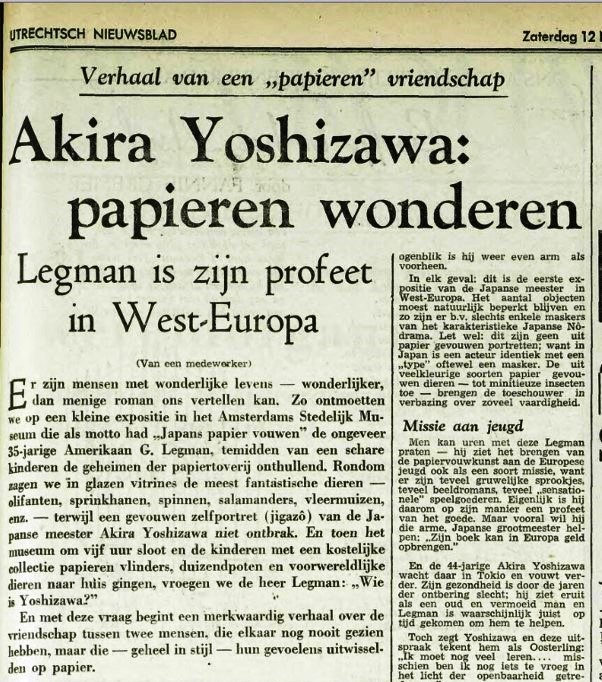
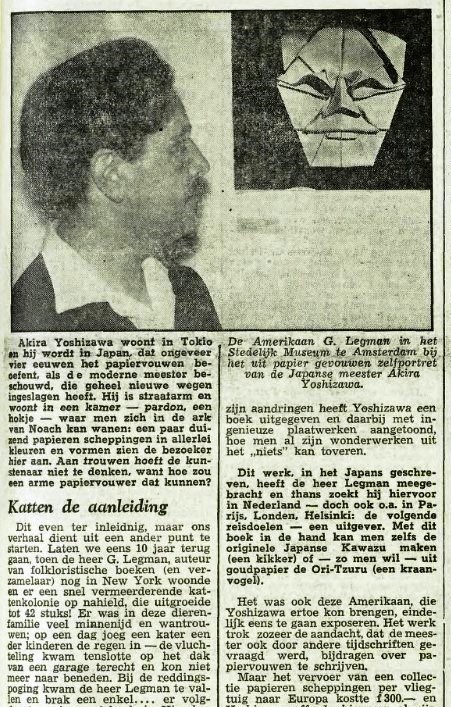
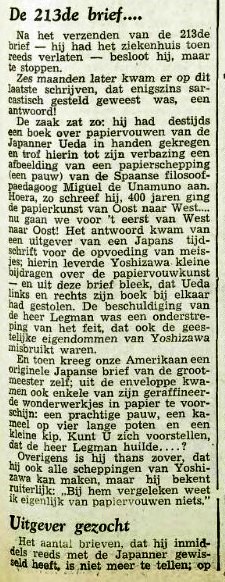
This article is about the Japanners Vouwen Papier exhibition held at the Stedelijk Museum in Amsterdam during October and November 1955. This article also appeared in Deventer Dagblad and Zutphens Dagblad on the following dat, where it was ascribed to Jaap Stigter. The headlines read: 'Story of a paper friendship: Akira Yoshizawa: Paper wonders: Legman is his prophet in Western Europe'. And, roughly translated, the main text reads: 'There are people with wondrous lives more wondrous than many a novel can tell us. Thus, at a small exhibition in the Amsterdam Stedlijk Museum, which had the title 'Japanners Vouwen Papier' we met the approximately 35-year-old America G Legman revealing the secrets of paper magic amidst a crowd of children. All around us, in gass display cases, we saw the most fantastic animals - elephants, grasshoppers, spiders, salamanders, bats etc., while a folded self-portrait of the Japanese master Akira Yoshizawa was not missing. And when the museum closed at five-o-clock and the children went home with a precious collection of paper butterflies, centipedes and primeval animals, we asked Mr Legman, 'Who is Yoshizawa?' And with this question begins a curious story about the friendship between two people who have never seen each other but who, entirely in style, exchange their feelings on paper. Akira Yoshizawa lives in Tokyo, and in Japan - which has known paperfolding for about four centuriues - he is regarded as the modern master who has blazed entirely new trails. He is destitute and lives in a room - or rather a cubicle - where one might imagine oneself in Noah's Ark: A few thousand paper creations in all colours and shapes stare back at the visitor here. The artist need not think of getting married for how could a poor paperfolkder do that? Cats are the reason This serves as a brief introduction, butn our story must start from a different point. Let us go back ten years, to when Mr G Legman, author of folklore books (and collector) was still living in New York ansd kept a rapidly multiplying cat colony that grew to fortytwo animals. There was much jealousy and distrust within this animal family. On day a tomcat chased one of the kittens into the rain -the fleeing cat eventually landed up on the roof of a garage and could not get down. During the rescue attempt Mr Legman fell and broke his ankle - there followed two years in hospital. Here he began reading books about Japanese folklore and encountered the beauty of paper folding. He thought, 'I'm going to try that too. That's a good distraction.' But how to begin without a usable manual? He sent letters to all the major universities in Japan. No answer. New letters followed to every conceivable institution, but no one wished to answer him. After sending the 213th letter - by which time he has already left the hospital - he decided to stop. Six months later, a response to his last letter, which had been somewhat sarcastically worded, arrived. The matter went like this: He had come across a book on paper folding by the Japanese author Ueda, and, to his surprise, found within it an illustration of a paper creation (a peacock) by the Spanish philosopher-pedagogue Miguel de Unamuno. Hooray, he wrote, for 400 years the art of paper went from East to West ... now for the first time we are going from West to East. (He wrote to Mr Ueda.) The reply came from the Japanese published of an educational magazine for girls ... to which Mr Yoshizawa contributed short pieces on the art of paper folding - and from this letter it became clear that Ueda had plagiarised his book from various sources. Mr Legman's accusation highlighted the fact that Yoshizawa's intellectual property had also been misused. And then our American received an original Japanese letter from the grand master himself. From the envelope also emerged a few of his refined little paper wonders; a beautiful peacock, long legs, and a small chicken. Can you imagine that Mr Legman wept? Incidentally, he is now at the stage where he can make all of Yoshizawa's creations, but he frankly admits, 'Compared to him I actually know nothing about paper folding.' Publisher wanted The number of letters that he has meanwhile exchanged with the Japanese man is uncountable. At his insistence, Yoshizawa published a book and demonstrated with ingenious illustrations how one can conjure all the wonders out of nothing. Mr Legman has brought this work, written in Japanese, with him, and he is currently seeking a published for it in the Netherlands, but also in Paris, among other places, London, Helsinki, the next travel destinations. With this book in hand one can even make the original Japanese frog or, if one wishes, the Crane out of gold paper. It was also this American who managed to persuade Yoshizawa to finally exhibit. The work attracted so much attention that the artist was also asked by other magazines to write contributions about paper folding. But the transport of a collection of paper creations by aircraft to Europe cost 300 guilders and Yoshizawa sacrificed all his recent fees for this. At the moment, he is just as poor as before. In any case: this is the first exhibition of the Japanese master in Western Europe. The number of objects naturally had to be limited, so for example, there are only a few masks from the characteristic Japanese Noh drama. Mind you, these are not portraits; in Japan, an actor is identical to a "type," or mask. The animals, folded from multicolored types of paper into meticulous insects, leave viewers in awe at their skill. Mission to European youth You can talk for hours with Legman. He views the introduction of the paper folding art to European youth also as a kind of mission, for there are too many gruesome fairy tales, too many graphic novels, too many "sensational" toys. In fact, he is therefore also, in his own way, a prophet of good. But above all, he wants to help that same, Japanese grandmaster: "His book can bring in money in Europe." And 44-year-old Akira Yoshizawa is waiting there in Tokyo and continues to fold. His health is poor due to years of hardship; he looks like as an old, tired man, and Legman has probably arrived just in time to help him. Yet Yoshizawa says, and this statement marks him as an Easterner: "I still have a lot to learn... maybe I stepped into the public eye a little too soon..." **********
**********
**********
********** |
|||||||