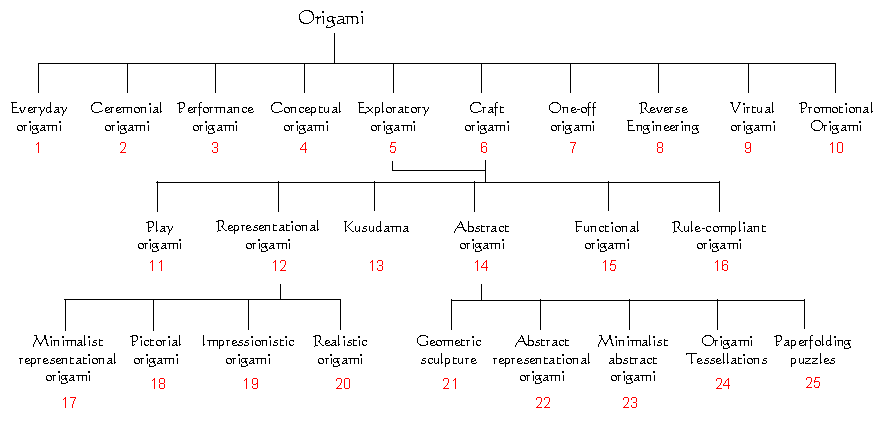
| 1 |
|
Everyday
origami is paperfolding which serves a
practical everyday purpose and which forms part
of the general culture of a society as a whole
rather than the special culture of the origami
community. Examples of everyday origami are
wrapping presents, weakening paper by folding so
that it can be torn apart, folding letters to
insert them in envelopes, or folding photocopied
sheets into booklets, party invitations etc.
Functional origami can become everyday origami if
it is disseminated sufficiently widely. |
| |
|
|
| 2 |
|
Ceremonial
origami is paperfolding carried out for
ceremonial or religious purposes. In Japan
ceremonial origami largely concerned the folding
of wrappers - called noshi or tsutsumi - for
gifts of flowers etc associated with particular
religious festivals throughout the year. In China
it is more associated with the folding of Yuan
Bao (gold nuggets) which are burned at funerals.
This style of origami is now largely of
historical interest and significance. |
| |
|
|
| 3 |
|
Performance origami is
about using paperfolding to produce entertaining,
amusing, or sometimes magical, effects. There are
two different kinds of performance origami:
Performance origami in which the
effect lies in the folding process itself,
usually in a 'surprise' denouement to the folding
sequence.
Performance origami in which the
effect is achieved by the manipulation of the
finished paperfold. Troublewit is a classic
example.
|
| |
|
|
| 4 |
|
Conceptual
origami is the most difficult type of
origami to understand or explain. Conceptual
origami uses the conventions of origami design,
diagramming, or culture to make a serious,
humorous or satirical comment about (usually)
origami itself or (occasionally) wider issues. |
| |
|
|
| 5 |
|
Craft origami is
what most people would think of when they hear
the word origami. Craft origami embraces both the
process of creating designs that are intended to
be reproducible and the process of reproducing
them from personal or recorded tuition, from
diagrams, or by reverse-engineering.
The reproduction part of craft
origami is not a sterile process. In reproducing
the chosen design the folder seeks to personalise
it - by careful choice or manufacture of the
paper, by the application of folding and
finishing skills, and often also by varying the
finishing folds to produce an enhanced aesthetic
effect.
Craft origami can be divided into
representational, abstract, play and functional
origami. There are individual notes on each of
these
|
| |
|
|
| 6 |
|
Virtual
origami is origami without folding
paper. This is not as crazy as it sounds.
Experienced model-making paperfolders can often
look at a paperfold for the first time and
reconstruct the basic folding sequence in their
minds. It is a short step from that to being able
to visualise a finished model that you want to
design and 'unfolding' it to work out how it
could be made.
In
addition, origami designers, particularly
result-orientated designers working in the
model-making field are increasingly using
mathematical design techniques and only realising
their models in paper once the design process is
at an advanced stage.
|
| |
|
|
| 7 |
|
Exploratory
origami is the hands-on
(trial-and-error) investigation of the
possibilities inherent in the paperfolding
process. |
| |
|
|
| 8 |
|
Origami puzzles are
puzzles which relate to the qualities and
configurations of folded paper.
Origami puzzles come in two distinct
kinds - those which can be solved by trial and
error while folding or manipulating paper (a form
of exploratory origami) and those which can only
be solved by mathematics (perhaps a form of
virtual origami).
It is important to distinguish
between origami puzzles and origami models of
puzzles which were originally designed in another
medium such as plastic or wood. The folding of
such models is a type of model-making origami.
|
| |
|
|
| 9 |
|
Representational
origami is a form of craft origami which
seeks to represent objects and living beings in a
recognisable way. This can be done either by the
merest suggestion (minimalist origami) or by
attempting to achieve a high degree of
verisimilitude (model-making origami).
|
| |
|
|
| 10 |
|
Play origami is a
form of craft origami concerned with the
realisation of paperfolds which can function as
manipulative novelties or toys. Many traditional
paperfolds - including the Flapping Bird - fall
into this category.
Playground folds
are folds which are in common use by children in
the playground. In UK the most common playground
folds are the basic paper dart from a rectangle
and the Fortune Teller from a square. (Playground
folds could also be considered to be a form of
Everyday Origami.)
Paper Aircraft are
a variety of play origami, but one that is now
taken quite seriously in some quarters (thanks
largely to the Guinness Book of Records).
Flexagons are
fascinating novelties made by folding and weaving
strips of paper into polygonal forms. These forms
can be flexed in many intriguing ways to alter
the appearance of their visible surfaces.
Flexagons are not strictly origami - but are
definitely origamic.
Origami Games are
games specifically designed to be played by
folding paper or which require paperfolds as
essential apparatus (eg Jumping Frog races).
Making folded paper versions of existing games
that normally using apparatus made of other
materials (eg origami versions of Tangrams) is a
form of model-making origami.
|
| |
|
|
| 11 |
|
Abstract
origami is a form of craft origami which
is about the folding of geometric and decorative
forms. Usually such forms are produced by
straight-line folds alone, but the use of curved
crease lines is becoming more common.
Straight-line folds in one part of the paper can
also be used to induce curves in other areas of
the same sheet..
Abstract
origami forms are generally either single-piece
or modular. Modular origami is a technique in
which sheets of paper are folded into modules or
units which are then combined into two or
three-dimensional abstract forms.
|
| |
|
|
| 12 |
|
Functional origami
is a form of craft origami that is intended to
serve a practical purpose around the home or in
the work-place.
Most functional objects -
containers, photo-frames, stands etc - are
single-piece paperfolds, though there are many
excellent modular boxes.
Ornaments may be considered a form
of functional origami. Most of the best origami
ornaments are modular, though there are some fine
single-piece designs as well.
|
| |
|
|
| 13 |
|
Minimalist origami is
a form of representational origami that seeks to
capture the essence of a subject in the smallest
possible number of folds (usually between 1 and 5
- though there is no hard and fast rule).
|
| |
|
|
| 14 |
|
Pictorial
origami uses paper which is white one
side and a single plain colour the other (or a
different plain colour each side) to create flat
(but not necessarily rectangular) two-colour
images of objects, figures, landscapes etc. Many minimalist
folds are pictorial, since this technique
dramatically increases the representational
potential of a few simple folds.
|
| |
|
|
| 15 |
|
Model-making origami seeks
to model plants, living creatures, or inanimate
objects in folded paper.
Enthusiasts for this type of origami
often subscribe to the ethic that origami should
be single-sheet and tend to prefer designs that
are as realistic as possible.
This combination of the single-piece
ethic and a desire for realism brings the
designer straight up against the limitations of
paperfolding technique, so it is not surprising
that most of the advances in single-sheet origami
technique have been achieved by designers working
in this field.
Model-making origami is the most
popular form of craft origami. Indeed many
paperfolders (even paperfolding clubs) tend to
concentrate on this form of origami to the
virtual exclusion of everything else.
|
| |
|
|
| 16 |
|
Geometric
origami is a general term for the
folding of single-piece or modular geometric
forms. Geometric origami is often produced
as a by-product of exploratory origami. It is
important to realise that although its value in
terms of exploratory origami may be high this
does not necessarily translate into value as
craft origami. Unfortunately too many badly
differentiated examples of this type of origami
are diagrammed (often on a
stream-of-consciousness basis) with the result
that the (much rarer) good quality work produced
in this style is often under-valued.
|
| |
|
|
| 17 |
|
Abstract
sculpture is a form of abstract origami
that seeks to produce aesthetically appealing
form by folding paper. Many designers have
produced single-sheet sculpture
using techniques which vary from twist folding
through cross-pleating to random crumpling.
Modular
sculpture is abstract sculpture produced
by modular origami.
Macro-modular
sculpture is abstract sculpture produced
by combining simple modular assemblies into
larger structures.
|
| |
|
|
| 18 |
|
Mathematical modelling
means the folding of polyhedra or tiles/tiling
patterns.
Tiles and/or tiling patterns are
usually folded from multiple single-sheets.
Polyhedra can be folded either from
single sheets or, usually more effectively, from
modules.
In a similar vein, modular origami
has been used to model molecular structures,
particularly the structure of fullerenes.
|
| |
|
|
| 19 |
|
Origami
tesselations are a form of abstract
origami in which multi-layer tilings are produced
from a single large sheet of paper by a technique
known as twist folding. |